Sunday, 13 November 2011

Thoracic Mobility


Thoracic spine mobility is an extremely important component in dynamic movement and in everyday life, and it can often be overlooked. Poor thoracic mobility can affect the shoulder, neck, lower back, and hip very easily.  
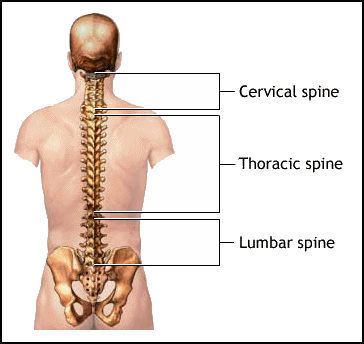

Unfortunately, our daily habits and posture make us all very prone to poor thoracic spine mobility.


In the MatchFit clinic it is quite common to see people with a flexed spine, rounded shoulders and overly tight paraspinal muscles all contributing to poor thoracic mobility. This lack of movement in the mid spine will lead to restricted rotation and extension and also to restricted shoulder movements. To perform optimally in training and to perform required motions without injury requires good thoracic mobility and shoulder range of motion. 

Here are a few Thoracic Mobility exercises that you can perform to help enhance your spinal mobility. 

This first clip shows how you can use two tennis balls to act as a pivot for extension at various segments of the spine.


Video from Michael Boyle

This is a nice, simple exercise to start increasing the movement in the thoracic spine.

Another good drill to emphasise thoracic extension can be performed seated against a wall. This may be difficult for people with tight lats or shoulder problems.


As well as working on extension it is also beneficial to work on rotation, as a form of injury prevention, to help posture and increase mobility in the spine.

Video from Michael Boyle

Twist using small movements, adding a small amount of extension at each segment. Be careful to make sure the movement is not coming from the lower back (lumbar spine) in this drill. Hips should remain facing forward and core tight with the movement coming from the thoracic area. This drill can also be done seated on a chair.

Next up is a drill in the Quadruped position (hands & knees) a popular position for mobilising the spine, shoulders and hips. Like the seated movements, having the hips in flexion here limits the amount of lumbar spine movement allowed. People with poor hip mobility may struggle to get into this position.

Video from Eric Cressey 

With the elbow bent and hand on the back of the head, reach through the gap between hand and knee on one side then open out to point the elbow towards the ceiling. Repeat on both sides.

It is common to use a foam roller to help thoracic mobility, this clip shows how you can use one effectively to incorporate extension and rotation.


Video from Mike Reinold

Simple foam rolling to start with will loosen off the soft tissue of the thoracic spine reducing tightness that may contribute to poor mobility. Roll up and down spending time on areas that feel particularly tight. Next move onto extension, working on various stiff segments of the spine, repeating about 10 extension mobilisations at each. Lastly you can work on rotation. Make sure the lower back is stable and the movement comes from the thoracic area, extending the arms up towards the ceiling allows for good visualisation of the amount of rotation achieved, you only need to rotate a small amount.

Encouraging thoracic mobility is important for maintenance of good shoulder mobility, something integral to any athlete. Normal thoracic-humeral rhythm is important for injury prevention. Thoracic mobility becomes increasingly important in athletic overhead activities. The higher an athlete raises their arm, the more thoracic motion is needed from the thoracic spine to maintain the proper relative shoulder alignment.


Shoulder movement available with different thoracic spine positions
Normal scapular and thoracic spine motion allows optimal mechanics for athletic shoulder motions (left). Increased thoracic kyphosis, reduced thoracic mobility, or scapular protraction caused by rounded shoulders and tight anterior muscles can contribute to shoulder impairment and injury (right). The rhythm between the thoracic spine, scapular and shoulder joint is fundamental to maintaining enough space in the joint to prevent impingement, a very common injury seen in overhead athletes with poor thoracic mobility.

Start working on freeing up that thoracic spine!


Friday, 7 October 2011

KINESIO TAPE

The Kinesio Taping Method is a definitive rehabilitative taping technique that is designed to facilitate the body’s natural healing process, while providing support and stability to muscles and joints without restricting the body’s range of motion. It provides extended soft tissue manipulation to prolong the benefits of any manual therapy and massage administered by Sports Therapist.

Brightly coloured tape, wearable for 3 to 5 days at a time to provide 24-hour results to the patient. The Kinesio Taping Method is a therapeutic taping technique not only offering support, but also rehabilitating the affected condition. By targeting different receptors within the body the Kinesio Tape alleviates pain and facilitates lymphatic drainage.


Kinesio Tape can be applied in hundreds of ways and has the ability to re-educate the neuromuscular system, reduce pain and inflammation, enhance performance, prevent injury and promote good circulation and healing, and assist in returning the body to to its natural state.


TOM DALEY

In some cases, the treatment of a condition may require treatment of other underlying conditions by a Sports Therapist at MatchFit but Kinesio Tape can be a valuable addition to any treatment session.  It has been proven to have positive physiological effects on the skin, lymphatic and circulatory system, fascia, muscles, ligaments, tendons, and joints. It can be used in conjunction with a multitude of other treatments and modalities we use at MatchFit and is effective during the rehabilitative and chronic phases on an injury as well as being used for preventative measures.

DAVID BECKHAM
Kinesio Tape is becoming widely used in the world of elite sport.


KINESIO TAPING IS COMING TO MATCHFIT – Claire is soon to become a certified Kinesio Tape Practitioner. This is a great addition to variety of treatments we already offer and we could be using it on you soon!

Check out this short video of Kinesio Tape being used in professional NFL Football with the Greenbay Packers.

Sunday, 15 May 2011

World Youth Rugby Tournament

Once a year, the best Japanese teams oppose nominated teams from the greatest rugby Nations around the globe, in an unofficial School Rugby World Cup. Many previous participants have gone on to play professional rugby and play in the senior Rugby World Cup. Hence school teams are often affiliated to Academy programmes of elite Domestic sides.

This year, the RFU nominated Ivybridge Community College (Exeter Chiefs) to represent England and claimed a major scalp in beating South Africa (DHL Stormers) in the semi-final. Ultimately we lost out to New Zealand (Waikato Chiefs) in the final in what was our most physical match of the tournament.

Staring down the haka

Whilst we played in honour of those affected by the natural disasters to have hit Japan, Ivy took solace in  holding NZ to the narrowest winning margin of the tournament. At 35-17 it goes without saying they were a strong and clinical side... Shame they can't win a World Cup eh?

We made the final in good health, all things considered. Lucky and relieved considering our tour preparation. One player only returned to rugby 2 weeks before leaving, following 6 months of post-operative ACL rehabilitation. Another ruptured his ACL 3 months prior and is still awaiting surgery.  An incredible achievement for him to play in 5 of 6 games. Both players were still working hard on their rehab during the tournament and it obviously payed off. They contributed tries, passion, blood, sweat and tears.
ACL tape by Matsui san
Unstable single leg squat w extra g.med & hams

This was a trip of firsts. Some of our players hadn't been on a plane before, used chopsticks, been to a museum, eaten sushi, played infront of a crowd, sang the God save the queen, or signed an autograph. Perhaps for some, this opportunity truly was the trip of a lifetime. It was also the last game some of the players would play for their school, so there were a few exhausted man tears on the battlefield come the final whistle. Understandably so.

I really enjoyed working with the team during this tournament. At times the boys surpassed themselves with their spirit and decorum under pressure. It was a pleasure spending time with such admireable young men. Although I may have now got over my jet-lag, I haven't yet got over the trip.

Sayonara...

Sunday, 24 April 2011

Golden Warriors

Congratulations to Team MatchFit athlete Tom Barlow who competed and won Gold at the 2011 Brazilian Jiu Jitsu British Open. Victor, Tom had been looked after pre-competition by MatchFit Therapist Claire Jones with regular soft-tissue work and strapping to support an injured ankle which held up to prevail .in the adult feather weight category.

Hannah Gorman also won Gold in her category, Hannah has been taking part in the MatchFit Warrior Workout conditioning sessions taking place at Master St James Black Belt Academy & MMA Fitness Centre in Plymouth.

Well done Warriors.

Wednesday, 30 March 2011

Looking Before You Leap... Landing Mechanics


You walk before you can run. You must look before you leap. Now you must land before you can jump… Why?

There are two main reasons for practicing your landing mechanics. One is injury prevention and the other is power production. Naturally it is best advised to train to avoid injury before making you more powerful. It won’t matter how high you jumped if you crumble in a world of pain on landing. As an athlete the joints in your lower body are exposed to forces that far exceed your own body weight, by as much as 10-15 times.

Proper jump training will teach you to absorb these forces using your muscles primarily, instead of your joints. In doing so you should be at a reduced risk of injury, including ankle sprains and serious knee injuries such as anterior cruciate ligament tears. Principles and coaching points learnt here can be applied to other sporting movements and exercises, such as squats, lunges and Olympic lifts.

You may exhibit one or more of the following traits that can be seen in the adjacent picture:
  • Hips collapsing (pelvic tilt & body lean)
  • Knee instability (moving towards body midline)
  • Ankle pronation (foot flattening)

Start basic landing technique training with 1-2 exercises 2-3 times per week.  Keep the sets and reps simple (2-3 sets x 6-10 reps) as it should be considered an accessory exercise.  It should be performed early in a workout, after a quality dynamic warm-up and prior to the strength portion of your training. Exercises below are advisable...


Drop Jumps
Standing on a low bench. Step off with one foot and fall to the floor in a soft and quiet two-footed landing that absorbs force through the entire body in an athletic stance ruled by mid foot pressure. After the first 2 reps, maintain the landing position for 5 seconds before moving.

When landing, force is absorbed with triple flexion of the lower extremity. Sit back on the gluts (butt out) instead of extending the knees forwards far past the toes. Doing so unloads strain on the ACL and plays to your body's strengths by utilising your gluts for powerful movement. 

Band Resisted Squat
Tie a resistance band around your thighs just above the knees when your legs are together. Then step your feet shoulder width apart or slightly wider, taking up resistance on the band. 


References:
Baechle & Earle (2008). Essentials of Strength Training & Conditioning, 3rd Ed; Human Kinetics, US 
Hauschildt, M. (2008). NSCA Performance Training Journal; 7(1): 13-16


Thursday, 10 March 2011

The Greatest Stretch In The World

One fundamental difference between athletes and gym monkees is an appreciation for the importance of an appropriate warm-up. When time is short, it can be the first thing thrown out the window, next go the tekkers and then the cool down. You may have succeeded in suitably exhausting yourself in the alotted time but what's the aim of the game? If it's to be the best you can be - ultimately faster and stronger for longer - then adopt an athlete's state of mind.

Prepare yourself to perform at your best... And if time really is short, adopt this dynamic stretching routine from Discover Movement. Watch the video below:


Best performed after a short 2 minute pulse raiser the routine prepares you by progressively moving and stretching your neuromuscular system in functional gross chain, full body, patterns. Warmed up and ready to go in under 5 minutes. Boom.

Sunday, 20 February 2011

Breezy's Masterclass

My colleague at Ivybridge Community College is none other than the Former Commonwealth Weightlifting Gold Medalist and Olympian Micheala Breeze.


Click on the link below for the featured video in which she gives us the low down on the Olympic Weighlifting disciplines as well as a little on her life as an elite athlete. The video also features GB Weightlifter Helen Jewell training at the Ivybridge Weight Room.

Breezy's Weighlifting Guide